+44
2039 362224
+44
2039 362224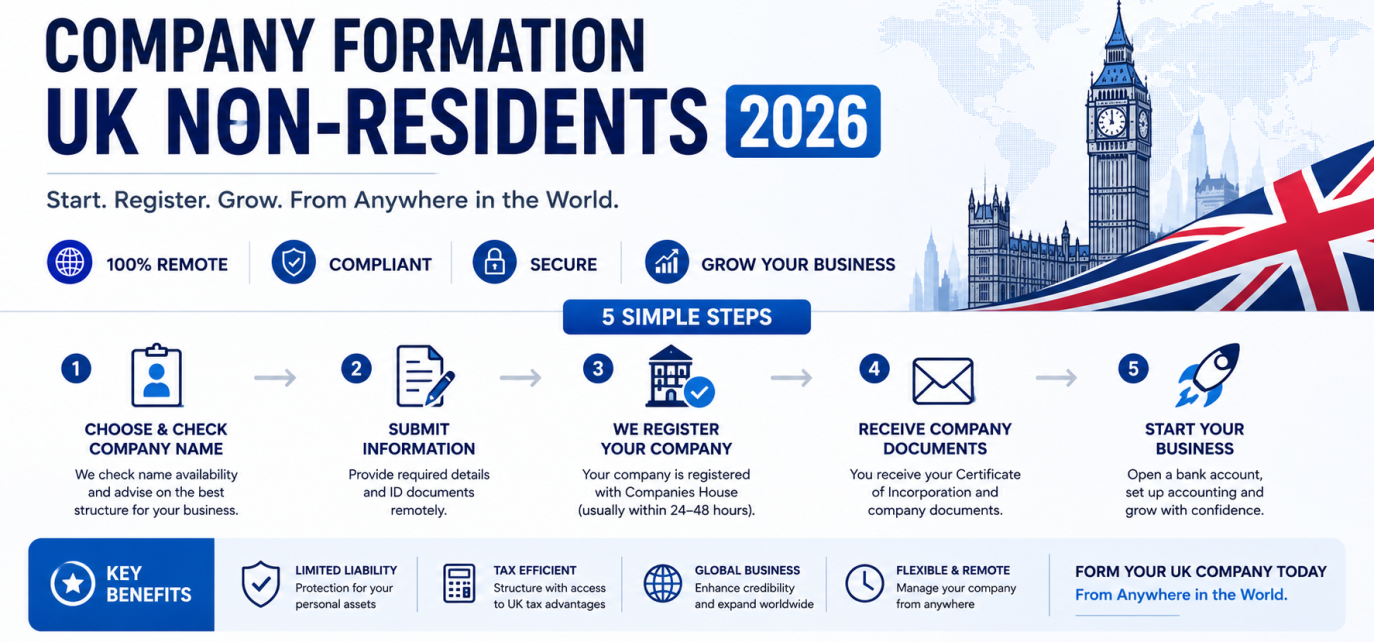
You don’t need to set foot in London to own a piece of the British market. There is a common misconception that launching a business in the United Kingdom requires a local visa, a British partner, or a physical storefront. In reality, the UK operates one of the most open-door jurisdictions in the world, allowing international founders 100% legal ownership from anywhere on the globe.
Completing a company formation for non-UK residents is about much more than just filing paperwork. You are essentially giving birth to a "separate legal entity"—a legal person entirely disconnected from you, meaning the business can sign contracts, open bank accounts, and take on debt in its own name. According to global trade data, trading under a UK limited company acts as a digital passport of prestige, instantly signaling trust to global clients whether you are a consultant in Lagos or a software developer in Lima.
All of this administrative magic happens through Companies House, the UK government's official agency that creates and records every legal business in the country. In practice, this agency treats domestic and international founders almost identically, making it incredibly straightforward to register a UK company from abroad without hiring expensive lawyers. This streamlined public register is exactly why UK business formation remains a top choice for digital nomads seeking high credibility.
Navigating foreign administration might feel intimidating from afar, but the actual requirements are surprisingly minimal once you understand the basic components.
Please watch the video given below to learn more:

Do You Need a Visa or a British Partner?
Wondering, "Do I need a UK visa to start a business?" The short answer is no. Because your company is its own legal person, its nationality is British, even if yours is not. Operating a non-resident business from your laptop abroad requires no immigration papers, because owning a UK asset is entirely separate from having the right to live there physically.
Managing the daily operations makes you a non-resident director, while owning the "pie" makes you a shareholder. You can easily hold both roles simultaneously without surrendering a single slice to a local British partner. These common misconceptions often deter founders:
Myth: You need a local co-founder. Fact: The UK completely allows 100% foreign ownership.
Myth: Travel documents are mandatory. Fact: Visas are for residing in the UK, not for company registration.
Myth: You need special legal clearance. Fact: You simply need to be 16 or older with a valid government ID.
Knowing these doors are completely open gives you the freedom to structure your enterprise with confidence.
The "Limited Company" vs. Branch Office: Which Path Should You Take?
When expanding from abroad, you face a choice: register a standalone UK limited company or open a branch office of an existing business. A private limited company (Ltd.) is usually best because it creates a legal shield. This "limited liability" means the business handles its own debts. If your online store fails to pay a supplier, your personal savings back home stay completely protected.
Evaluating a limited company vs a branch office for foreigners reveals clear differences in daily operations:
Independence: A UK Ltd is a separate legal "person," while a branch office is tied directly to your home company, exposing it to overseas legal risks.
Banking: Financial institutions strongly prefer local Ltds. Getting a branch account approved without UK residency is notoriously hard.
Taxation: The benefits of a UK private limited company include simple, separate tax filings. Branches dangerously tangle your domestic and UK tax records together.
Selecting this structure drastically reduces your administrative headaches by bypassing the complex international paperwork that slows down branch offices.
Gathering Your "Ingredients": What You Need Before You Start
Navigating UK company formation for non-residents takes just 12 minutes if you have these four details ready on your desk:
A unique company name
A registered UK address
Officer details
Your share structure
Choosing a title requires checking the Companies House register to ensure your idea is completely original. You then agree to a "Memorandum of Association"—think of this as a written handshake where all initial founders legally promise to form the business. The government provides standard memorandum and articles of association templates, saving you thousands in legal fees.
Next, define your "Share Capital," which is simply the total number of ownership slices your business is divided into. Imagine your company as a pie. If you are a solo e-commerce seller, you can create just one slice worth £1 and keep it, owning 100%. With a co-founder, you might create 100 slices at £1 each and split them 50/50.
Authorities also need to know who is pulling the strings. Alongside listing directors and shareholders, you must follow the person with significant control disclosure rules. A Person with Significant Control (PSC) is simply anyone holding over 25% of those pie slices or voting rights.
The Virtual Office Hack: How to Get a UK Address Without Renting an Office
A common hurdle for international founders is that UK law insists your business must have a physical footprint. To meet registered office requirements, you need a specific address where government agencies can send official legal notices. This differs completely from your trading address, which is simply where you do your daily work—even if that means typing on a laptop in Bali.
Figuring out how to get a UK business address from afar is simple thanks to the virtual office workaround. Instead of signing an expensive commercial lease, you pay a small annual fee to a provider acting as your official legal mailbox. This shortcut safely satisfies the government mandate while keeping your personal home address permanently hidden from public records.
Once established, virtual registered office address services handle the logistics seamlessly by scanning and emailing official letters directly to your inbox the moment they arrive. With your unique name, share structure, and physical location secured, your preparation phase is officially complete.

A Walkthrough of the Companies House Application
With your ingredients prepped, the UK company setup is surprisingly fast. You can complete the entire application on the official GOV.UK portal in under 20 minutes. There are no hidden broker charges here; the direct government registration fee is a flat £100 (2026), making your total cost of entry incredibly low.
Following the digital prompts is straightforward. The chronological path is simple:
Create a Government Gateway ID (your secure digital login).
Enter your approved company name and new virtual address.
Assign director and shareholder details (even if both are just you).
Select your SIC code to define your business activity.
Pay the £100 fee using a standard credit or debit card.
Step four often causes unnecessary panic, but a "SIC" code is simply a five-digit number telling the government what your business does. If you build software, pick the code for software development; if you run e-commerce, select retail. The portal also generates standard "Articles of Association"—a prewritten rulebook for running your business that safely satisfies Companies House requirements for overseas owners without needing a lawyer.
Within 2 to 7 days of submitting, you will receive a digital "Certificate of Incorporation" via email. Think of this document as your company’s legal birth certificate, proving it officially exists in the real world.
The "Bank Account Hurdle": How to Get Paid in GBP from Anywhere
Having your legal incorporation certificate in hand feels like a victory, but a rude awakening often follows when trying to access British banking. High-street banks in London generally require a physical meeting and UK utility bills, making opening a business bank account for non-residents nearly impossible through traditional routes. Submitting applications to institutions that are fundamentally unequipped to handle international founders rarely yields results.
The modern workaround is to use an Electronic Money Institution (EMI). Think of an EMI as a highly regulated digital bank; it gives you a real UK account number and sort code to receive British pounds, but everything is managed via an app. This approach completes your UK company formation with a bank account for non-UK residents seamlessly from your living room.
Several top-tier EMI platforms specifically cater to global digital nomads and overseas founders:
Wise Business: Excellent for multi-currency holding and low exchange rates.
Revolut Business: Offers physical corporate cards and easy team expense tracking.
Payoneer: Widely integrated with e-commerce marketplaces like Amazon.
Occasionally, these digital platforms (or a local bank in your home country) will ask for apostille certification for corporate documents to verify your new business. An "Apostille" is simply an internationally recognised government stamp—like a universal notary seal—proving your UK legal certificates are genuine.
Your Yearly "Chores": Taxes, Filings, and Staying Legal
Running a legitimate UK business requires a few mandatory updates to prove your company is active. Your primary contacts are Companies House (the public registry) and HMRC (the UK's tax authority). Every year, you must submit a confirmation statement. Unlike a tax return, this document simply confirms that your statutory registers and annual return filings—like your registered address and ownership details—remain accurate.
Missing deadlines triggers automatic government fines, so you need a reliable 'Annual Filing Calendar' to stay compliant:
Confirmation Statement: Due exactly one year after your incorporation date.
Annual Accounts: Your financial summary, due 9 months after your financial year ends.
Tax Return: Due 12 months after your accounting period ends.
Handling the tax obligations for foreign company directors means mastering two final concepts. First, you must pay corporation tax for non-resident business owners directly on the profits generated by your UK company. Second, watch out for the Value Added Tax (VAT) threshold. VAT registration becomes mandatory once your UK sales hit the specific £90,000 threshold.
Your 7-Day Action Plan to a Fully Operational UK Business
Setting up a business across borders used to require expensive flights and mountains of paperwork. Now, geographic location doesn't limit your commercial reach. Establishing your new legal entity is primarily a matter of gathering the right digital ingredients and following public guidelines.
To translate this into momentum, follow this timeline for your first week:
Day 1 (Prep): Search for an available name and secure a non-resident UK company formation package to obtain your registered office address.
Day 2 (Register): Submit your details for company formation for UK non-residents online.
Days 3-5 (Wait & Banking): Receive your official certificate and apply for a digital multi-currency business account.
Day 7 (Launch): Send your very first invoice to officially launch your UK business setup.
Start by checking if your desired business name is available on the Companies House register. The British market is fully accessible to international founders, and establishing your professional presence requires only a systematic approach to these foundational steps.
Click to get in touch with us to receive a customized quote.
#ukcompanyformation #nonresidentbusiness #ukbusiness #companyregistration #companieshouse #startupuk #businesssetup #entrepreneur #uklimitedcompany #globalbusiness #businessguide #ukstartup