+44
2039 362224
+44
2039 362224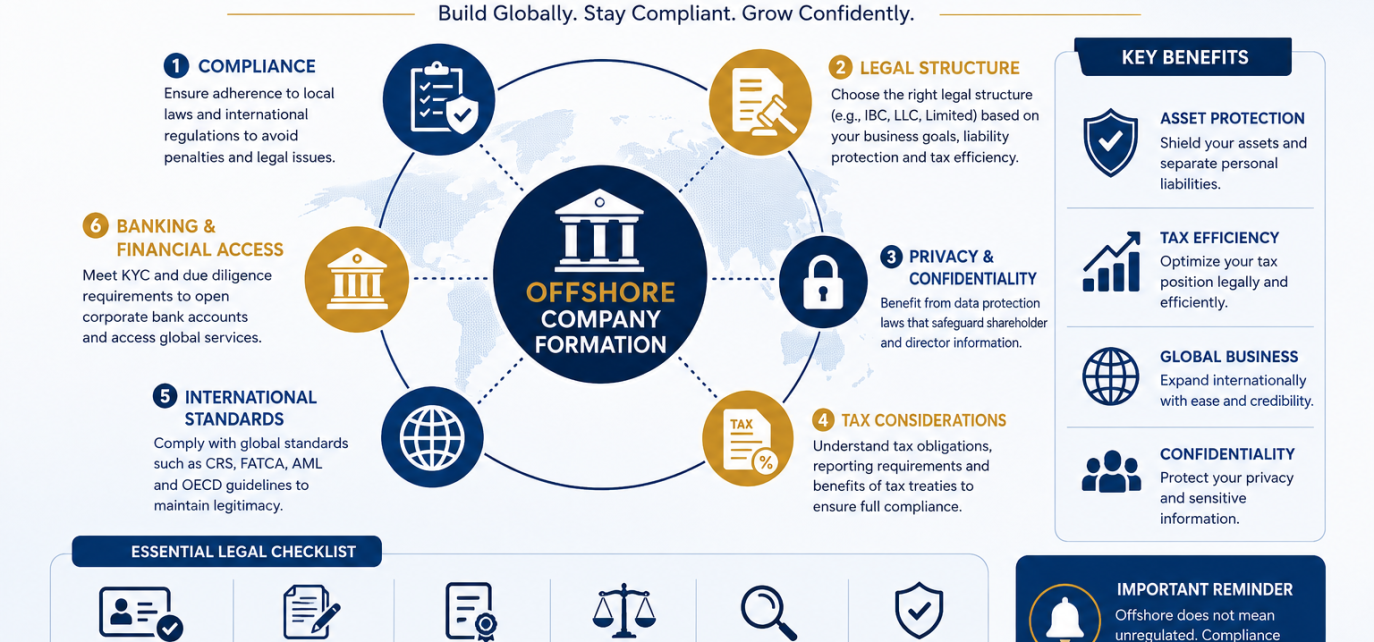
“Offshore company” is one of those phrases that can sound mysterious—or worse, suspicious. In practice, it simply means you’re forming a legal entity in a country (or territory) outside your home country. People do this for all kinds of legitimate reasons: entering a new market, holding international assets, working with foreign partners, or streamlining cross-border operations.
That said, offshore company formation isn’t a shortcut around the law. It’s a legal and compliance-heavy project, especially if you’re a U.S. person or you do business in (or with) the United States. The right structure can be useful; the wrong setup can create expensive reporting obligations, banking headaches, and reputational risk. This guide walks through the main legal considerations to keep in mind before you start the offshore company setup process. It’s educational—not legal or tax advice—so involve a qualified attorney and tax professional for your specific situation.
What Is an Offshore Company? Key Concepts and Benefits
An offshore company is a business entity registered in a jurisdiction different from where its owners live and/or where day-to-day business is carried out. The entity could be a corporation, an LLC-type structure, a partnership, or another form, depending on local law.
Common, legitimate reasons people form offshore companies include:
Cross-border operations: hiring internationally, signing contracts locally, or holding local permits.
Risk management: separating assets and liabilities across entities.
Access to banking and payments: depending on where customers and vendors are located.
Commercial flexibility: ownership structures, investment, and joint ventures that fit international needs.

Benefits are discussed a lot online, but the key point is this: the “benefit” only matters if the company is properly formed, managed, and reported. Many of the biggest problems people run into aren’t about incorporation—they’re about ongoing compliance.
Choosing the Right Jurisdiction for Offshore Company Formation
Jurisdiction choice is not just about fees or how fast you can register. It determines what you can legally do, what you must disclose, how banks will view you, and what compliance looks like year after year.
When comparing jurisdictions for offshore company registration or offshore company incorporation, focus on:
Corporate law and governance: director duties, shareholder rights, recordkeeping, annual filings.
Transparency rules: beneficial ownership reporting, public registries, privacy limitations.
Economic substance expectations: Some places require real local activity (staff, office, decision-making) for certain types of income.
Treaties and international alignment: how the jurisdiction interacts with global tax and reporting regimes.
Reputation and bankability: a jurisdiction that’s “cheap” can be harder to bank with or explain to partners.
Political/regulatory stability: sudden rule changes can be more costly than a higher upfront fee.

If you’re choosing between multiple “offshore incorporation services,” ask them directly how they handle beneficial-owner disclosures, substance rules, and banking introductions—and what they don’t handle (for example, U.S. reporting forms).
Legal Requirements and Compliance for Offshore Companies
Every jurisdiction has its own formation rules, but the compliance themes are similar. You’ll typically need to handle three layers: local company law, banking/AML requirements, and cross-border reporting in the owners’ home country.
Common legal and compliance requirements include:
Incorporation and governance documents: articles, registers, resolutions, and authorized signatories.
Ongoing filings: annual returns, renewals, registered agent obligations, and sometimes audited accounts.
Accounting and records: keeping books, invoices, contracts, and proof of business purpose.
AML/KYC compliance: Banks and service providers will request detailed information about owners, sources of funds, and expected transactions.
International reporting: depending on your profile, information may be exchanged under frameworks like CRS, and U.S.-connected accounts can be impacted by FATCA.
If you’re a U.S. taxpayer, “offshore business” activity can trigger additional reporting and tax rules. Depending on ownership, control, income type, and accounts, this can include things like reporting foreign financial accounts and foreign entities (for example, forms commonly associated with foreign corporations/partnerships or specified foreign assets). The details matter—get U.S. tax advice early, not after the company is formed.
Non-compliance isn’t just a technical issue. It can lead to penalties, banking freezes, inability to pay vendors, or forced dissolution in the offshore jurisdiction.
The Offshore Company Formation Process: Step-by-Step
While details vary, a typical “forming offshore company” workflow looks like this:
Clarify the business purpose: what the company will do, where clients are, where management will happen, and what assets it will hold.
Select the jurisdiction and entity type: for example, an LLC-style entity vs. a corporation, based on liability, governance, and tax treatment.
Choose a name and prepare documents: incorporation documents, shareholder/director details, and internal governance paperwork.
Appoint required roles: registered agent, registered office, and—if required—local directors or officers.
File and obtain the registration: after filing, you’ll receive certificates/registry extracts needed for banking and contracting.
Set up operations: accounting, contracts, invoicing, and (where necessary) evidence of substance.
Implement compliance and reporting: calendars for renewals, filings, and owner-level reporting obligations.
One practical tip: don’t treat offshore formation as a one-time project. Build a compliance checklist from day one (who files what, when, and where), and keep it updated as laws change.
Opening a Bank Account for Your Offshore Company
Banking is often the hardest part of setting up an offshore company, not incorporation. Many people can register an entity quickly but then spend weeks (or months) trying to open an account.
Expect the bank to ask for the following:
corporate documents (certificate, registry extract, bylaws/operating agreement)
IDs and proof of address for beneficial owners and signers
An explanation of the business model and expected transaction flow
source-of-funds/source-of-wealth information
contracts or invoices that show real commercial activity
Also, plan for ongoing monitoring. Banks can request updates over time, especially if transaction patterns change. If you’re specifically looking for “offshore company formation with bank account,” make sure the provider is clear about what is guaranteed (usually nothing) versus what they can realistically assist with (introductions and document preparation).
Working with Offshore Company Formation Agents and Services
Most people use offshore company formation agents because they already have the local relationships and know the filing steps. A good provider can save time; a bad one can leave you with an entity you can’t bank, can’t operate, or can’t properly report.
Offshore company formation services commonly help with:
jurisdiction and entity-type options (based on your stated needs)
document preparation and filings
registered agent/office arrangements
basic compliance reminders (renewals, local filings)
banking introductions (not the same as guaranteed account approval)
If you’re asking “who can help set up an offshore company,” look for firms that are transparent about compliance and limitations. It’s a red flag if a provider promises secrecy, “zero paperwork,” or “no reporting.”
Risks, Challenges, and Long-Term Considerations
Offshore structures can be useful, but they come with real trade-offs. The most common challenges aren’t dramatic—they’re operational:
Regulatory drift: rules and disclosure requirements evolve, sometimes quickly.
Banking friction: more scrutiny, more documents, slower onboarding.
Tax complexity: the entity may be legal offshore, but owners may still owe tax and file reports at home.
Substance expectations: “paper companies” without real operations can be questioned by banks or regulators.
Reputation risk: partners may ask questions; you’ll want a clean, explainable story.
In other words, the advantages of offshore company structures tend to show up when the business has a clear cross-border purpose, and the owners are willing to do the compliance work consistently.
Conclusion: Is Offshore Company Formation Right for You?
Offshore company formation can make sense when it supports a real international business need—especially when you plan for compliance from the beginning. The legal considerations aren’t optional, and they don’t end once your offshore registered company is approved.
If you’re considering offshore business formation, start by defining the business purpose, then speak with a qualified attorney and tax advisor (particularly if you have U.S. connections). With the right structure and good documentation, an offshore company can be a practical tool—not a problem waiting to happen.
Click to get in touch with us to receive a customized quote.
#offshorecompany #offshoreformation #internationalbusiness #businesscompliance #companyregistration #offshorebusiness #corporatestructuring #globalbusiness #businesslaw #taxplanning #entrepreneurship #offshorebanking